rajahamzaasghar - SEO Strategist & Organic Growth Expert

The Real SEO Roadmap for Pakistani Businesses (2026 Update)

Most Pakistani businesses want to grow but the growth stays flat. It’s not because they don’t do marketing. In most cases, the real problem is lack of information about which digital channel actually works and how. There are a lot of ways to promote a business. In this article I am covering one specific channel: SEO, and how it grows a business organically, the actual sequence I follow, not just a list of tactics.

In my last 10 years, almost every time a business owner and I sit down to discuss SEO, their first question is about rankings. For me, SEO was never about rankings, impressions, or clicks. I measure success on two things only. First, is my client actually getting leads. Second, are those lead numbers growing month over month. If the answer to both is yes, that’s a successful SEO campaign, everything else is a vanity number. That’s why this is a complete roadmap, updated for 2026, not just a checklist of old tricks that stopped working.

Why SEO Deserves Your Focus

SEO is probably the most underrated channel in Pakistani digital marketing, mostly because owners assume it takes time to show anything. That’s not entirely true. Just last month I started a new campaign with zero authority, zero domain age, nothing to lean on except pure keyword research. I built a 6 page website, generated content with AI assistance and then rewrote and fact checked every line myself rather than publishing low effort output, and within one month impressions had grown past 2.6k. Foundation work done properly moves faster than most owners expect.

CAsestudy

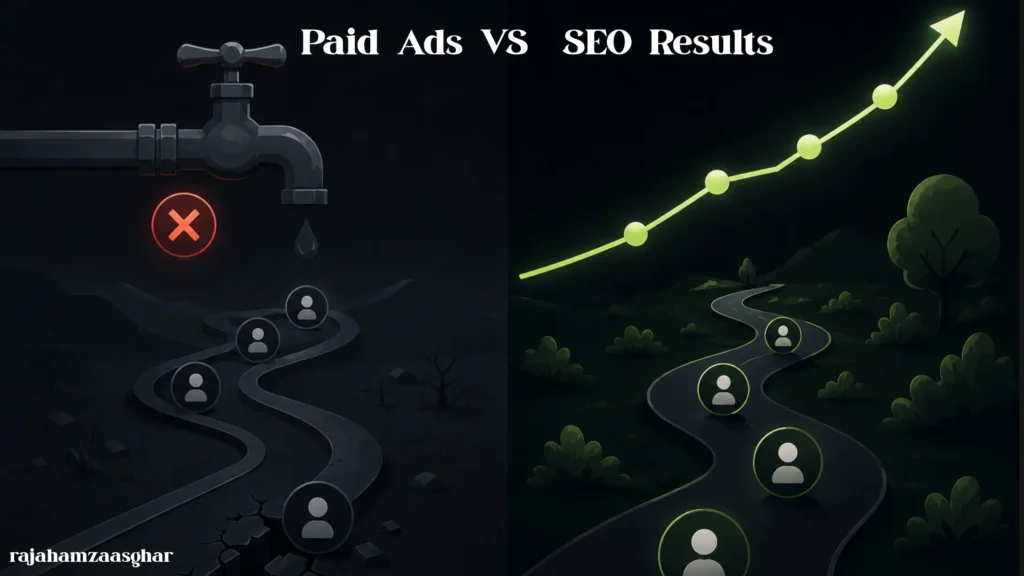
There are four real reasons a business should focus here. SEO puts you in front of a hot audience, people who already know their problem and are actively searching for the solution, you just need to be visible when they search. It builds brand visibility over time, the same way Hostinger, Mailchimp, Shopify, and Ahrefs became recognizable names largely through consistent visibility rather than paid reach alone. It gives stable, consistent results instead of a tap that shuts off the moment ad spend stops. And it compounds into long term growth, a page ranking well today keeps pulling leads a year from now without new spend.

Content is what actually powers that visibility. Publish content around your business niche, on your website and on social platforms, and the right audience, people who already need what you offer, start finding and hiring you through it. That’s the real difference between SEO and paid marketing. In paid marketing, money stops, leads stop. In SEO, once a page earns its place on Google, it tends to hold that position and keep sending leads with no ongoing spend attached to each one.

Stage 1: Setup Website and Google Business Profile

If you’re starting SEO for a business, there are two things to get right before anything else, your Google Business Profile, still commonly called GMB, and your website. GMB gets you found by people nearby. The website is where you can be found for anything beyond just location.

I’ll give you a real example. There’s a genuinely good food place near Anarkali, close to the Orange Line Lahore. I searched “hotel near me” expecting it to show up, and it didn’t. Only Ajwa Restaurant appeared nearby. I had to scroll and dig before I found a proper spot, a Nashta point, where I actually ate well, but it never showed up in that search either. That business is likely losing customers every single day simply because it isn’t set up to be found. That’s the entire cost of skipping this stage.

So once you’ve picked your business name, the first real task is claiming a Google Business Profile and buying a domain. If a full website isn’t ready yet, claim the GMB listing first regardless, so you aren’t invisible the way that hotel was.

Stage 1 GMB Explain

This is exactly where the 2026 update matters most. Local intent is moving fast toward zero click search. People read your reviews, glance at your map pin, and hit “Call” without ever opening your website. That means Stage 1 and Stage 2 now overlap in a way they didn’t a few years ago. Treat your Google Business Profile as a living page, not a one time form. Post regular updates, upload real geotagged photos from your actual location, and respond through Google’s direct messaging feature. A stale, unclaimed, or half filled profile now costs you customers before they ever reach your website at all.

Stage 2: Build Consistent Brand Visibility

I’ll be honest, I misunderstood this part of SEO for a long time myself. Branding, done consistently, works like a lead engine underneath everything else. Most businesses get this wrong in a very specific way.

Say your business is called Hamza’s Cafe. The name has to appear exactly the same everywhere it’s mentioned online, your website, your social profiles, your GMB listing, every post, every podcast mention, every promotion. Not “Hamza Cafe” in one place and “The Hamza’s Cafe” in another. The exact same string, every time. 

Google collects every mention of a brand and tries to group it into one single entity. If your name keeps shifting slightly, Google spends time and confidence deciding whether these are all the same business, and that delay works against you. 

Pick your exact name once, use it identically everywhere, and Google turns it into a recognized entity far faster. That entity status is what your rankings and brand positioning both quietly depend on.

Stage 3: Create Content That Actually Builds Something

Content, branding, and SEO together are one of the strongest lead generation combinations available, and yet most businesses barely touch content creation with real intent. Here’s an example worth sitting with. Funoon Fragrances, a Pakistani perfume brand now known well enough to run a physical store in Lahore, built its entire early audience through content. The founder started posting on TikTok from day one, long before there was a store to visit.

That’s why content sits in this roadmap and not outside it. People need to see what you do and how you actually do it, because by 2026 people are buying from a founder they recognize, not from a faceless company page. Content is the fuel behind everything else in this roadmap. More real content means more fuel, and more fuel means better rankings and more leads over time.

Here’s the part that changed recently. Google rolled out Preferred Sources tracking for AI Overviews in mid-2026, and that changes how content needs to open. AI systems are now pulling short, direct answers and quoting the source behind conversational results, so every page needs a clean, concise summary near the top, answering who, what, where, and roughly how much, before the deeper explanation starts underneath it. Bury your actual answer three paragraphs down and AI Overviews simply skip your page for someone else’s cleaner summary, even if your content is better overall.

FAQ sections need a mindset shift too. Google officially deprecated FAQ rich results for most standard sites, so the old trick of stacking FAQ schema purely to win a star rating or a drop down box on the results page doesn't work anymore. That doesn't mean drop FAQs. Writing them still matches real search intent well, people genuinely search in question form, and a good FAQ section still helps both readers and AI Overviews pull a clean answer. Just don't build your content strategy around chasing the old schema markup, chase the actual question someone is typing instead.

FAQ sections need a mindset shift too. Google officially deprecated FAQ rich results for most standard sites, so the old trick of stacking FAQ schema purely to win a star rating or a drop down box on the results page doesn’t work anymore. That doesn’t mean drop FAQs. Writing them still matches real search intent well, people genuinely search in question form, and a good FAQ section still helps both readers and AI Overviews pull a clean answer. Just don’t build your content strategy around chasing the old schema markup, chase the actual question someone is typing instead.

Stage 4: Build Real Branding

The last stage is branding itself, which for me means the perspective people carry about your product in their head, not the product’s features. Take the iPhone in Pakistan. Ask most people why they bought one and you’ll get the usual answers, camera, speed, Performance, Durability and so on. Very few actually connect it to something real in their life. They bought the perception. In Pakistan, an iPhone reads as a status symbol, carrying one signals wealth and influence to people around you. That’s branding doing its job.

The same logic applies to your business. Don’t just sell the product, sell the perspective behind it. I built my own personal brand “Raja Hamza Asghar” around one specific perspective, that I’m the SEO person who brings real leads, not just rankings. Decide what perspective you want people to walk away with about your business, and build every piece of this roadmap, your website, your GMB, your content, toward reinforcing that one idea consistently.

the power of branding

Frequently Asked Questions

Does SEO work for small businesses too?

Yes, often more so than for large companies, because ranking in the top local results in your own city can outweigh a much bigger competitor’s brand size and budget.

The old rich result star ratings and drop down FAQ boxes are mostly gone for standard sites. Writing FAQs still helps, both for matching real search intent and for giving AI Overviews a clean, quotable answer to cite.

It’s Google’s mid-2026 system for deciding which pages get cited as the source behind an AI generated answer. Pages with a short, direct summary near the top, before the deeper paragraphs, are far more likely to get picked.

Usually because the Google Business Profile was never claimed or was left incomplete. A website alone doesn’t fix local visibility, the profile does the heavy lifting for nearby, zero click searches.

Foundation work, GMB and basic site setup, can move within a few weeks. Content and branding compounding into steady, consistent leads usually takes a few months of consistent work, not one time effort.