
Quick Insights
A DFW fence company had a finished website, an active Google Business Profile, and social media in place, yet organic leads were at zero. The audit found the entire site set to noindex, along with heavy page load, no EEAT signals, almost no internal structure, and AI-generated content with no real expertise behind it. The fix started with a full design rebuild on Astra using a red and black theme, followed by a complete content rewrite built around a structured outline, real EEAT (before and after photos, founder experience), ten new pages, and ten new blog posts, all done within a month. Instead of publishing everything at once, the site went live gradually, page by page, so Google would not read it as a low-effort content dump. Within 28 days of going live, the site hit 33.4k impressions and 104 clicks, up from a site that had been invisible to Google entirely.
Main Content
A business owner comes to you with a website that looks finished. Design is done, Google Business Profile is set up, social media is active. Every box a checklist would ask for is checked. Then they tell you the part that does not add up. None of it is bringing in a single lead through organic search.
Most people would guess the content is weak, or the design is outdated, or the business just needs more posts. That is what I assumed too, before I opened the site properly. The real problem was sitting in one line of code, and it had been quietly killing the entire site’s chances with Google for months.

Why A "Ready-Looking" Website Can Still Get Zero Organic Leads
A finished-looking website can produce zero leads when Google is technically blocked from indexing it, when there is no structural or trust signal for the crawler to read, or when the content behind it was mass-produced without any real expertise behind it. Design and social presence do not fix any of that. Until the technical and EEAT foundation is in place, none of it reaches a search result page. This is the fence company’s story from the end of May, when I picked up the project, to where it stands now.
What The Audit Actually Found
The client, a fence company serving the DFW metro, came to me at the end of May. Site was live, GMB was claimed, and social accounts existed. He just could not figure out why none of it was converting into calls or quote requests.
I ran the audit the way I run every new project, top to bottom, no assumptions. The site had been set to noindex. Not one page, the whole site. Google had effectively been told not to bother showing any of it, ever.
That alone would explain zero leads on its own. It did not stop there. Page load was heavy, the kind that makes a visitor bounce before the fold even renders. There were no EEAT signals anywhere, no sign of who ran the business or why they should be trusted with a fence installation. Internal structure was close to nonexistent, pages sitting in isolation with nothing connecting them. And the UX had clearly never been looked at from a visitor’s point of view.
Digging a bit further explained the content problem too. It had all been generated by AI, with no structure, no local relevance, nothing a real expert would have written. It read like it was built to exist, not to be read.
Fixing The Design Before Touching Anything Else
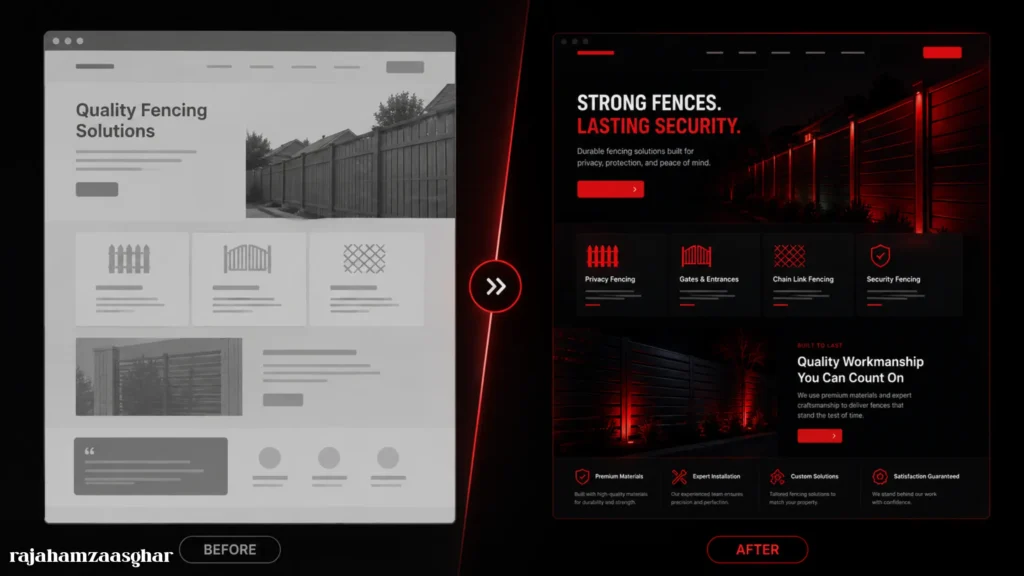
I started with what the visitor sees first. The site already had around 30 pages built, so this was not a rebuild from scratch, it was a full redesign pass on every one of them. I moved the theme onto Astra inside WordPress and rebuilt the visual identity around a red and black combination, keeping it tight to two core colors instead of the scattered palette it had before.
Getting the UX right mattered as much as the color choice. A visitor deciding whether to trust a fence contractor forms that opinion in seconds, and a cluttered or dated-looking site works against that before a single word gets read.
Building The Content Approach Before Writing A Single Page
Design fixed, the next problem was the content itself, since none of the existing pages could stay as they were. I sat down with the content writer and walked through exactly what this site needed, not just topics, but how each page should be structured and what it needed to prove to a reader.
I handed over the full playbook I have built for this kind of work, the outline logic, the kind of depth each section needed, how EEAT had to show up on the page instead of being mentioned once and dropped. It took a couple of trial rounds before the writer found the rhythm of it. Once that clicked, we moved fast.

Inside five days, every page on the site had updated content. I pulled real project photos, years of experience, and the client’s own back-story to build out genuine EEAT, none of it generic. The client happened to have before-and-after photos of completed jobs sitting on his phone, which turned out to be exactly the kind of first-hand proof that makes a page trustworthy instead of just descriptive. Those went straight onto the relevant service pages.
Alongside the rewrite, I found the right keywords, mapped internal links properly, and added ten new pages the site was missing to complete the structure. On top of that came ten new blog posts, a mix of cost questions, how-to content, and pieces meant to build the founder’s personal EEAT rather than just push a service.
The whole rebuild, design through content through structure, took about a month before the site went live again.
Why The Site Did Not Go Live All At Once
Here is the part most people get wrong when they finally fix a broken site. They take everything they built and push it live in one go. Twenty pages appearing in a week feels efficient. To Google’s helpful content systems, it reads as a low-effort content dump, and that is not the impression you want a recovering site to make.
This site actually had one thing working in its favor. It was 260 days old and had been sitting on noindex that whole time. That meant two things could happen at once once I lifted the block. Google could see the site had history, and it could watch new pages and posts arrive gradually rather than in a flood, three pages and two articles in one week, spread out instead of dumped.
I am not going to lay out the exact publishing schedule and crawl-budget logic here, that part is closer to a trade process than something to hand out in a blog post. What I will say is that it is far less forgiving than it sounds. Get the pacing wrong and pages sit unindexed, or the crawl budget gets burned on the wrong parts of the site before it ever reaches the pages that matter. Getting that timing right was what let the recovery hold instead of stalling out again.
Where The Numbers Stand Now
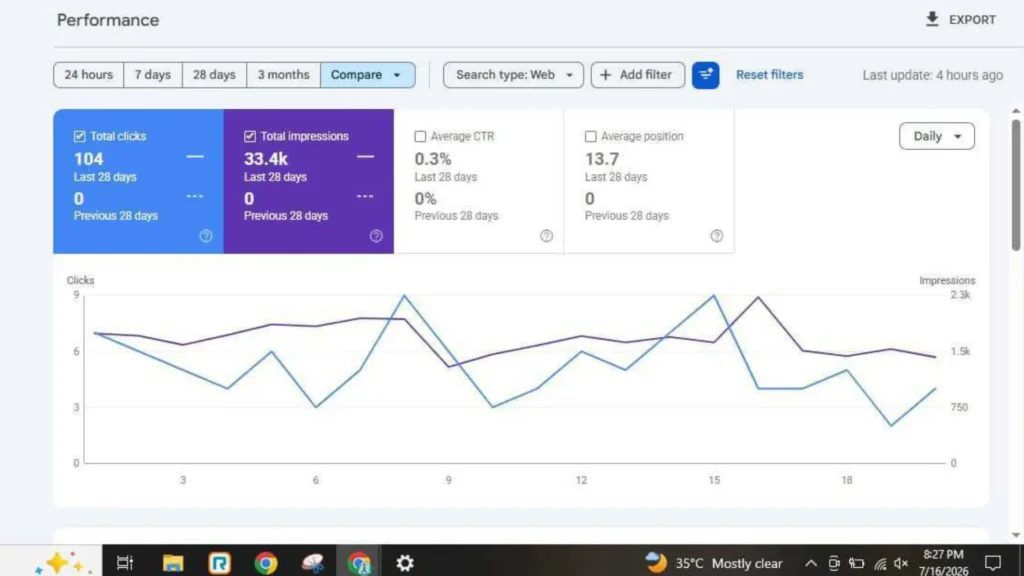
As of July 16, the site is sitting at 33.4k impressions and 104 clicks over a 28-day window in Search Console. For a site that spent 260 days invisible to Google before this project started, that is a real site now being read, crawled, and shown, not a blocked one waiting in the dark.
Clicks and CTR still have real room to grow from here, and that is expected this early into a fresh indexing history. Impressions climbing this fast off a noindex recovery says the technical and structural fix did its job. The next stretch of work is about pulling CTR and rankings up to match.
What This Means For Other DFW Local Businesses
If a business in Dallas-Fort Worth is sitting on a site that looks complete and is still not producing leads, the design or the content is rarely the actual starting point worth checking. Open Search Console first. Look for noindex tags, crawl errors, and whether Google has ever actually been let in.
DFW is a crowded metro for service businesses, fencing included, and the contractors doing well here are not winning on a nicer logo. They are winning since Google can read their site, trust what it finds, and has a clean structure to crawl through. Fix the foundation before spending another dollar on anything sitting on top of it.

Frequently Asked Questions
How long does a noindex-to-live recovery like this usually take to show results?
This one showed measurable impressions inside the first month of going live. Full ranking recovery and stable lead flow usually takes longer, three to six months is a realistic range depending on the niche and competition.
Could the client have found the noindex issue himself?
Most business owners never think to check. It is not something you would notice from the site looking fine on the surface, you have to go into Search Console or the page source directly.
Does going live with fewer pages first actually hurt initial traffic?
No. A gradual rollout protects the recovery instead of hurting it. A sudden dump of pages is what draws the low-effort content signal Google’s helpful content systems are built to catch.
Is this approach different for a brand-new site versus one recovering from noindex?
Yes. A brand-new site has no history to lean on, so the pacing logic and the risk tolerance around it are not the same. This particular approach worked off the site’s age and existing (blocked) history.

Raja Hamza Asghar
Raja Hamza Asghar is an SEO strategist and organic growth expert in Pakistan. I have 10 years of experience in SEO and have worked with many international and local clients in Pakistan. I started my journey in 2016 as an intern, and throughout my career I learned the core fundamentals of SEO, how search engines work, technical SEO, content marketing, etc. These experiences motivated me to open my own digital marketing agency and software house, which I created in 2019 with the name Digital Hamza. Later, in 2024, I also started an agency called SEO Gujrat. In both agencies, I have worked with many international and local clients in Pakistan.