
Quick Insights
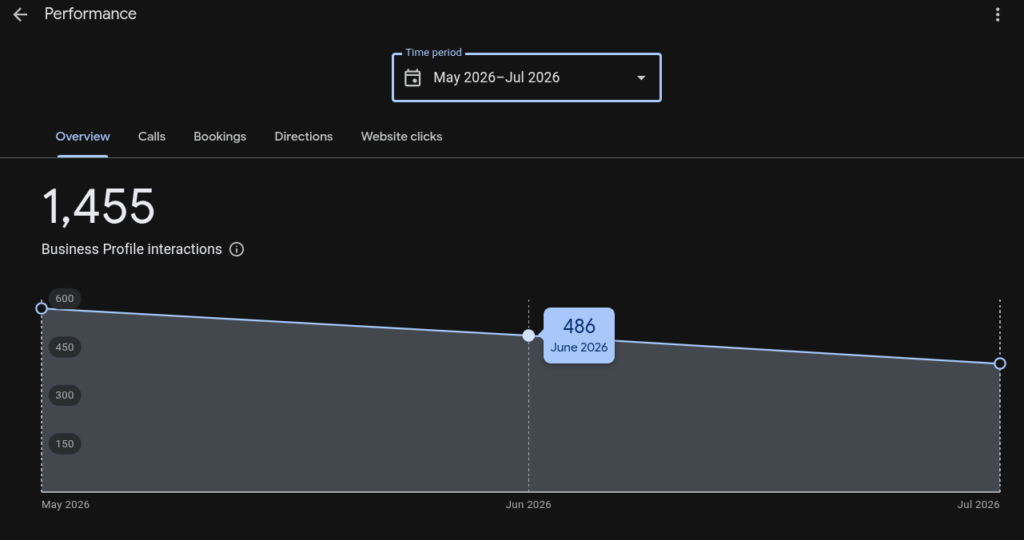
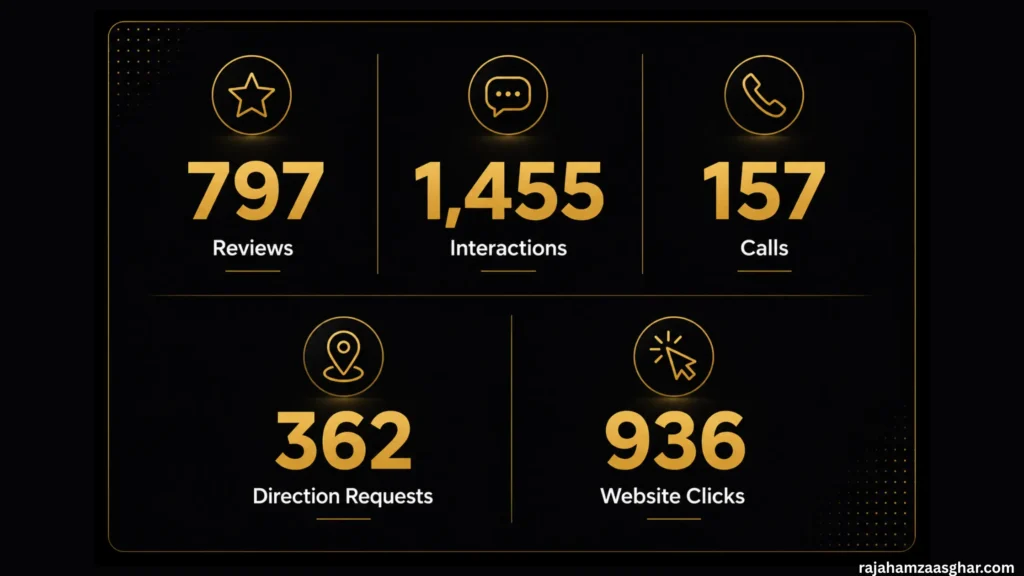
A Leeds barbershop reached out on LinkedIn in February 2024 wanting steady, sustainable clients rather than a one-time spike. Two years of focused Google Business Profile work followed: a defined service and audience, a QR-code review system instead of bought reviews, and consistent citation and category upkeep. By July 2026 the profile had 797 genuine reviews, 1,455 Business Profile interactions in three months, and roughly 138 real leads a month.
Main Content
A message came in on LinkedIn in February 2024 from a barbershop owner in Leeds looking for barber SEO help. The ask was simple on the surface: he wanted more clients. What came back wasn’t an agreement to start work. It was a question. Did he want clients, or did he want clients every month, the kind that keep showing up without the number swinging from ten one month to zero the next?
He didn’t hesitate on the answer. Growth that could actually be sustained mattered more to him than a quick spike he’d have to chase again in six weeks. That answer decided the whole shape of the work that followed, because a business that wants steady monthly clients needs a different foundation than one that just wants a burst of attention.
The First Meeting Decided Everything That Came After
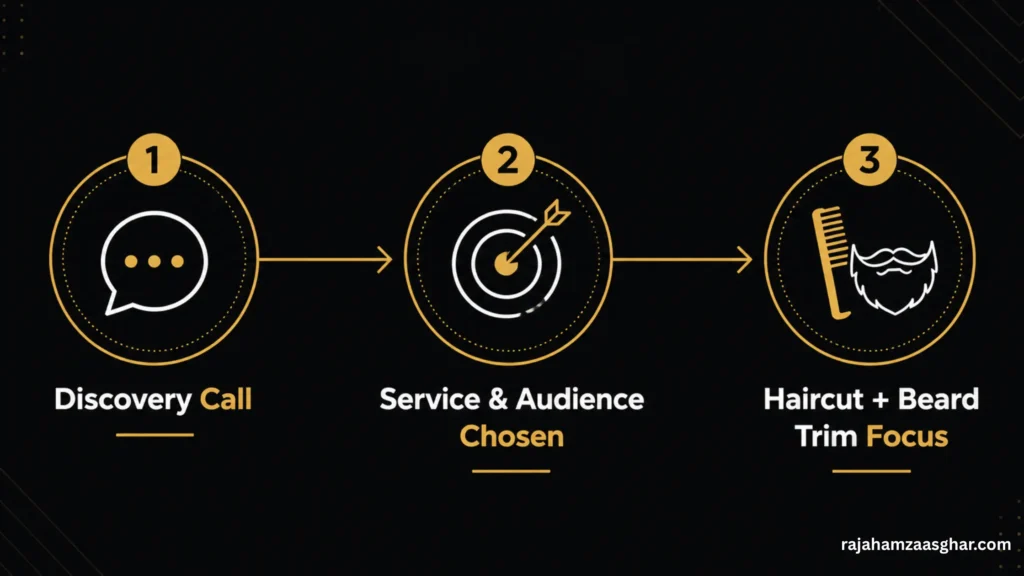
Before any technical work started, there was a first meeting to actually understand the business. Not a generic intake form, a real conversation about the business model, the surrounding area, and the shop’s exact location relative to who was walking or driving past it every day. A barbershop in a dense residential pocket of Leeds needs a different plan than one on a high street competing with six other shops in eyeshot.
Out of that conversation came the decision that shaped everything downstream: which service the shop should actually be known for, and which audience to build around it. The answer was top-of-the-line haircuts paired with beard trimming, aimed at men who wanted a proper, well-finished look rather than a five-minute trim. That focus mattered more than it might sound like it should. A profile and a website trying to be everything to everyone rarely rank well for anything specific, while one built clearly around a defined service and audience gives Google a much easier signal to match against a search.
Setting Up the Website, GMB, and Social Media Together
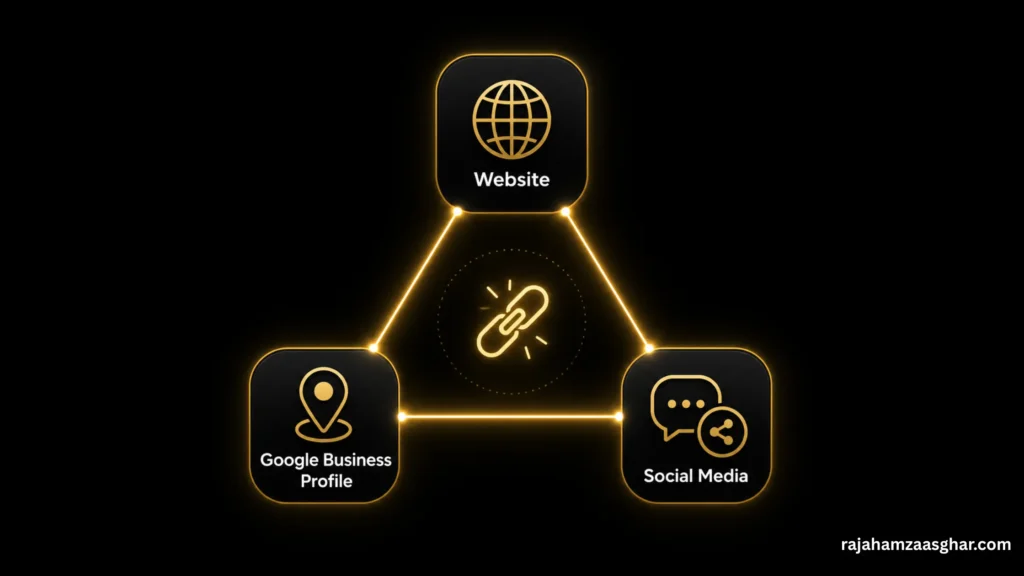
With the direction settled, the next phase was building the pieces properly rather than patching whatever was already there. A proper website went up, the Google Business Profile got built out correctly, and social media accounts were set up alongside both, all linked to each other rather than existing as separate, disconnected islands. A website that doesn’t link back to the GMB, or social profiles that never mention either, waste the trust each one could be lending to the others.
This is also where the reviews question came up, and it’s the part of this that tends to surprise people. The easy route, the one plenty of agencies still take, is buying fake reviews to make a new profile look established fast. That route was skipped entirely. Instead, a QR code was created and handed to the client to print and place near the shop’s door, positioned so a customer walking out after a haircut could scan it on the way past and leave a review right then, while the cut was still fresh in mind.
A Google Business Profile earns durable trust and ranking through genuine reviews collected at the actual moment a customer is satisfied, not through purchased reviews, which Google’s systems are increasingly able to detect and which put the entire listing at risk of suspension.
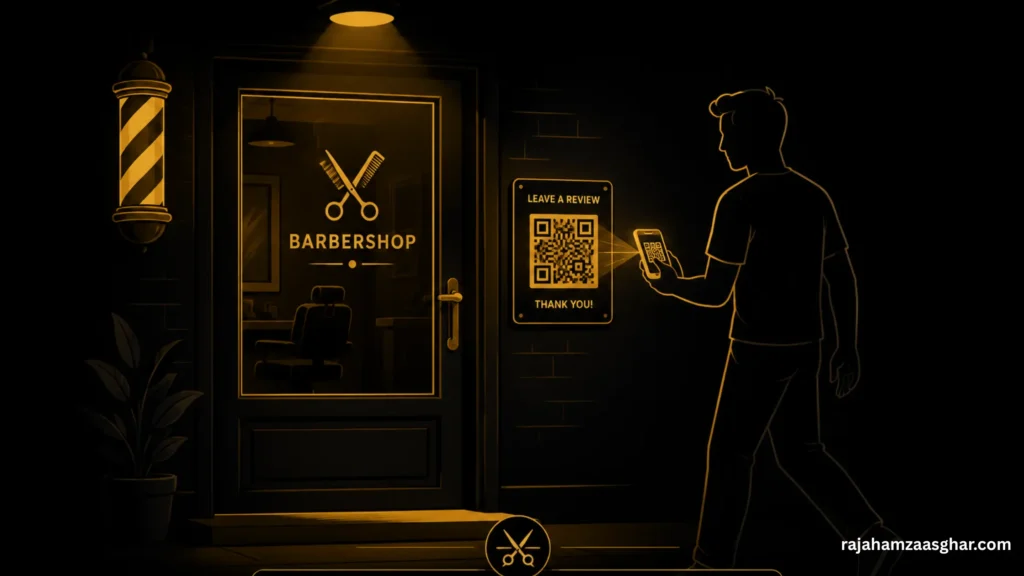
That timing mattered more than the QR code itself. Asking for a review days later, by text or email, catches people after the moment has faded and the request feels like a chore. Asking right at the door, right after the service, catches genuine enthusiasm while it’s still there. The client stuck with it consistently, and it shows: by July 2026, the profile had built up to 797 reviews, every one of them from an actual client walking out the door, not a batch bought in one afternoon.
The Technical Work Underneath the Reviews
Reviews on their own don’t carry a listing. Alongside the QR system, the Google Business Profile went through proper category and attribute work, since a barbershop miscategorized as a general salon, or missing basic attributes like walk-in availability, loses a chunk of the exact searches it should be winning. Services were listed out in full rather than left as a vague single line, photos went up on a regular schedule instead of once and forgotten, and citations across other directories got cleaned up so the business’s name, address, and phone number matched everywhere instead of contradicting each other from one directory to the next.
None of this was a one-time push. Two years on, the photo updates, the review responses, and the citation checks are still part of the routine, because a profile built once and left alone tends to plateau, and this one hasn’t been given that chance.
What Barber SEO Actually Produced by July 2026
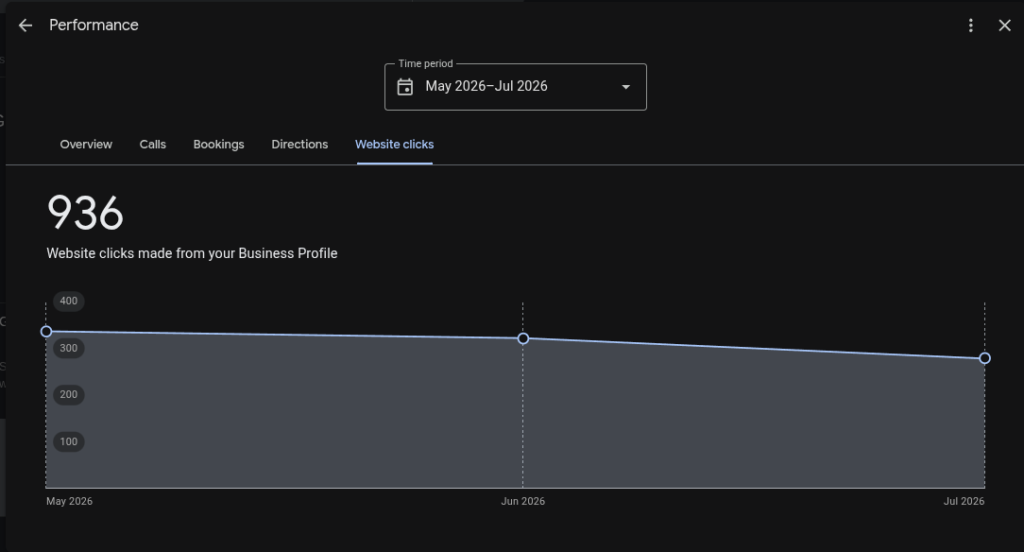
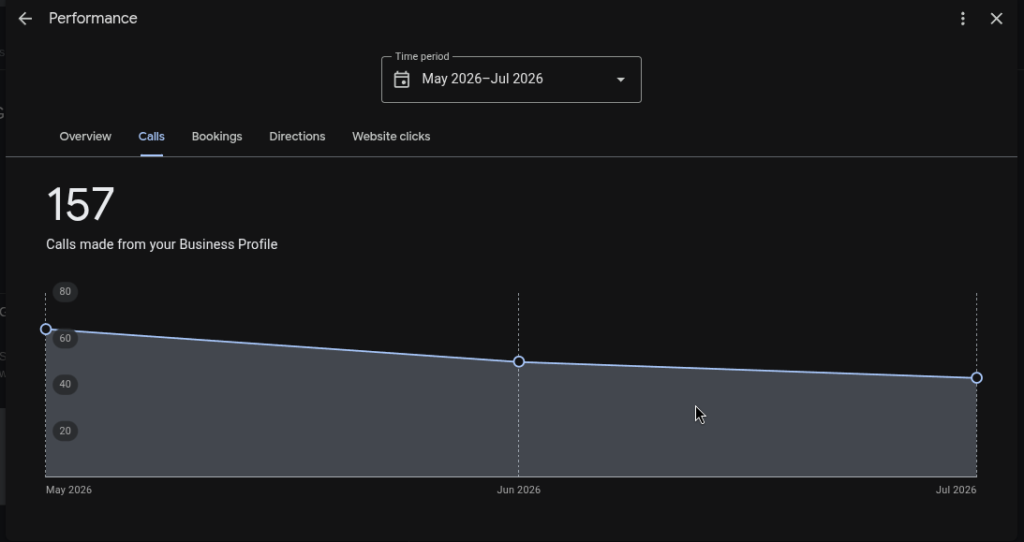
Over the three months of May through July 2026, the profile logged 1,455 total Business Profile interactions. Broken down, that’s 157 calls placed straight from the listing, 362 direction requests, and 936 website clicks, three separate categories that happen to add up to the full total with nothing left unaccounted for. June alone carried 486 of those interactions and 115 of the direction requests, which lines up with what you’d expect from a barbershop, people deciding they need a haircut and wanting to know how to get there.
Not every call or direction request turns into an actual booking, so the honest way to talk about leads is calls and direction requests combined, 519 over the three months, with a conservative 80 percent of those counted as genuine intent to visit. That works out to roughly 138 real leads a month, not every single interaction inflated into a lead the way some agencies present these numbers.
The profile was viewed 3,923 times across the window, and showed up in 844 separate searches that led someone to the listing. Most of that viewing happened on mobile, tracking with how people actually search for a barber. 65 percent came through Google Search on mobile, another 20 percent through Google Maps on mobile, with the rest split between Search and Maps on desktop. Nobody’s sitting down at a laptop to book a haircut. They’re doing it standing in the kitchen or on the walk to the bus stop.
The website carries less of the direct interaction volume but still pulls in somewhere between 20,000 and 25,000 impressions a month, which makes sense given how the whole strategy was built. The priority from that first meeting onward was pulling in local, nearby customers specifically, which meant putting the heaviest weight on the Google Business Profile rather than treating the website as the main channel. The website’s impressions back up the visibility. The GMB is what actually turns that visibility into a phone ringing.
What the Search Terms Themselves Reveal
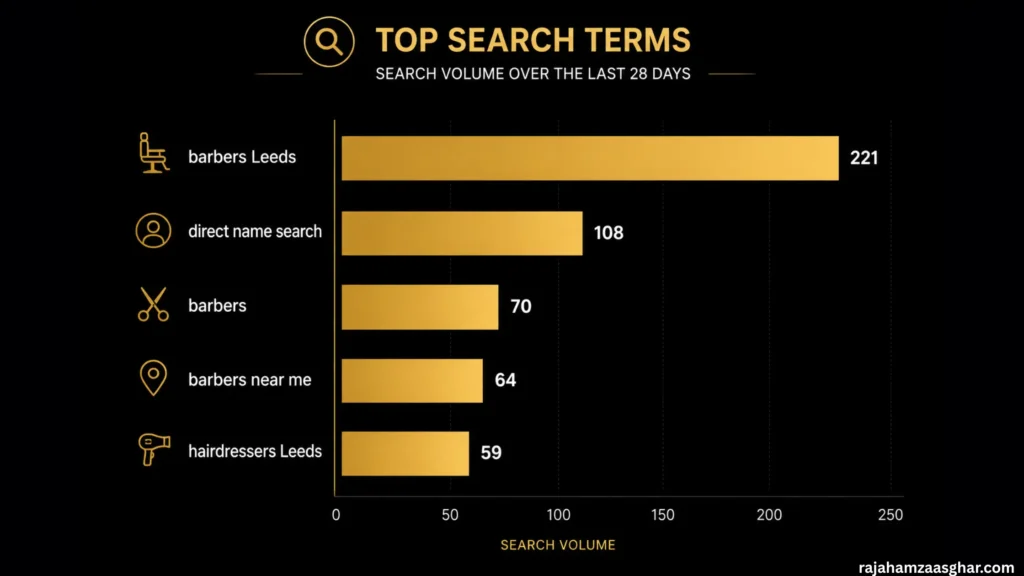
The specific queries bringing people to the profile tell their own story. The single biggest one was a plain “barbers Leeds”, 221 searches over the window, no brand name attached, someone just looking for the nearest option. Right behind that, 108 searches were people looking for the shop by name directly, a signal in its own right. That’s return customers and word-of-mouth referrals typing the business straight into Google rather than searching generically.
After that came “barbers” on its own, “barbers near me,” and “hairdressers Leeds,” in that order. None of these are exotic long-tail terms. They’re exactly what someone types with a haircut on their mind and twenty minutes to spare. The lesson buried in that list is that local SEO for a business like this doesn’t need clever keyword targeting. It needs the profile to be fully eligible to show up for the obvious terms, which is precisely what the category, attribute, and citation work was for.
What This Barber SEO Approach Means for Any Local Business
None of this is specific to barbershops, and it isn’t specific to the UK either. Any business that depends on someone nearby searching a plain, generic term, a tailor, a clinic, a repair shop, a salon, runs on the same mechanics: a clearly defined service and audience, a genuine review habit built into the actual customer moment, and a profile kept active rather than set up once and forgotten. Businesses outside the UK sometimes assume Google Business Profile matters less for them. It doesn’t. Anywhere Google Maps and Search are the default way people find a nearby business, the same mechanics apply.
The specific numbers here won’t transfer directly. A dentist’s profile won’t get 844 searches from three months of the same work, and a business in a smaller town won’t see 3,923 profile views. What transfers is the shape of it: a defined service and audience decided before any technical work starts, reviews earned at the moment of service rather than bought, and consistent maintenance sustained over years rather than done once.

Where This Kind of Work Stops
It’s worth being honest about the limits. A fully optimized profile gets more people through the door faster, but it doesn’t fix a genuine service problem. A bad haircut still loses that customer for good, QR code or not. It doesn’t replace a website that needs to exist for its own reasons, and it won’t outrun a location problem. A shop tucked away with almost no passing foot traffic and few nearby searches has a lower ceiling than one sitting in a dense residential area, no matter how complete the listing is.
It also isn’t instant. This is two years of consistent, unglamorous maintenance, not a project finished in one sitting. Anyone expecting a single round of edits to hold up for years is setting themselves up for the same plateau this listing sat at before February 2024.
Frequently Asked Questions
Why not just buy reviews to get the profile looking established faster?
Because it doesn’t hold up. Google’s systems are increasingly good at spotting patterns that don’t match real customer behavior, and a suspended or penalized listing loses everything the fake reviews were supposed to buy. The QR code route took longer but built something that doesn’t have that risk sitting underneath it.
Does a Google Business Profile actually need ongoing work, or is setting it up once enough?
Once is not enough. A profile set up correctly and then left alone tends to plateau, because Google reads inactivity as a signal too. The photo updates, review responses, and citation checks here have run continuously for two years, not in a single sitting.
Is review count the main thing that decides local ranking?
No. It’s one input among several. Category accuracy, attribute completeness, citation consistency, and posting activity carried real weight here alongside the reviews, not instead of them.
How long before a business owner should expect to see results like this?
There’s no fixed timeline, and anyone promising one specific number of weeks is guessing. This profile needed roughly two years of sustained work to reach 797 reviews and this level of interaction, though the earliest movement, categories and attributes getting fixed, tends to show up faster than the review and citation work does.
Want this kind of growth for your barbershop?


Raja Hamza Asghar
Raja Hamza Asghar is an SEO strategist and organic growth expert in Pakistan. I have 10 years of experience in SEO and have worked with many international and local clients in Pakistan. I started my journey in 2016 as an intern, and throughout my career I learned the core fundamentals of SEO, how search engines work, technical SEO, content marketing, etc. These experiences motivated me to open my own digital marketing agency and software house, which I created in 2019 with the name Digital Hamza. Later, in 2024, I also started an agency called SEO Gujrat. In both agencies, I have worked with many international and local clients in Pakistan.